
RESEARCH & DATA
Dual Citizenship Statistics (2026): 51 Verified Facts and Figures
How many Americans hold a second citizenship, how many want one, where they are claiming it, and what Americans think about it. Every figure is linked to its original source and was checked twice, including an independent review.
Last updated: November 15, 2026
HOW MANY AMERICANS ARE DUAL CITIZENS?
7%
of U.S. adult citizens said they already hold another country's citizenship in a December 2025 survey. No U.S. agency publishes an official count of dual citizens.
Source: YouGov, December 2025.
Key statistics
- 7% of U.S. adult citizens said they are already a citizen of another country in a December 2025 YouGov survey.
- Prof. Peter J. Spiro, writing in Henley & Partners' Global Mobility Report, estimates that the 7% YouGov figure equates to around 25 million Americans and calls it almost surely an underestimate.
- 17% of Americans said they have considered becoming a citizen of another country, while 73% said they never have.
- A spring 2025 Harris poll found that almost half of Americans, and two-thirds of Gen Z and Millennial Americans, would like to have dual citizenship.
- 26% of Americans said U.S. citizens should have to give up U.S. citizenship if they gain another; 56% said they should not.
- By 2020, 76% of 200 countries allowed their citizens to acquire another citizenship without automatically losing their own.
- A record 18,910 people applied from the U.S. for Irish citizenship through the Foreign Births Register in 2025.
- A record 8,790 U.S. nationals applied for British citizenship in 2025, 42% more than the previous high of 6,192 in 2024.
- 6,600 U.S. citizens became German citizens in 2025, roughly double the number in 2024.
- Spain had granted 237,145 nationalities to descendants of exiles under its Democratic Memory Law as of September 2025.
ON THIS PAGE
- Dual citizenship and U.S. law
- How many Americans are dual citizens
- Interest in a second citizenship
- Public opinion
- Dual citizenship around the world
- Ireland
- United Kingdom
- Germany
- Spain
- Italy
- Canada and Mexico
- Giving up U.S. citizenship
- New U.S. citizens
- Documents for a second citizenship
- Methodology
- Cite this page and download the data
- Frequently asked questions
Dual citizenship and U.S. law
- U.S. law does not prohibit dual nationality, and it does not require Americans who acquire another citizenship to choose between them. U.S. Department of State#1
- U.S. dual nationals must use a U.S. passport to enter and leave the United States. U.S. Department of State#2
How many Americans are dual citizens?
We found no official U.S. count of dual citizens, so survey data is the best available measure.
- 7% of U.S. adult citizens said they are already a citizen of another country in a December 2025 YouGov survey. YouGov#3
- Prof. Peter J. Spiro, writing in Henley & Partners' Global Mobility Report, estimates that the 7% YouGov figure equates to around 25 million Americans and calls it almost surely an underestimate. Peter J. Spiro (Henley & Partners Global Mobility Report)#4
- 7% of Democrats and Independents and 5% of Republicans said they already hold another citizenship. YouGov#5
Interest in a second citizenship
- 17% of Americans said they have considered becoming a citizen of another country, while 73% said they never have. YouGov#6
- 25% of Democrats said they have considered becoming a citizen of another country, compared with 7% of Republicans. YouGov#7
- 15% of Americans said they would give up U.S. citizenship if they became a citizen of another country; 65% said they would not. YouGov#8
- A spring 2025 Harris poll found that almost half of Americans, and two-thirds of Gen Z and Millennial Americans, would like to have dual citizenship. Henley & Partners#9
- Applications for investor citizenship from Americans at Henley & Partners rose more than 75% in 2025, after a spike of over 400% in 2020; Americans are now the firm's largest pool of applicants. Henley & Partners#10
What Americans think about dual citizenship
In December 2025, a bill was introduced in the U.S. Senate that would end dual citizenship. A YouGov survey that month measured public opinion on the idea.
| Question (Dec. 2025) | All | Democrats | Independents | Republicans |
|---|---|---|---|---|
| Already a citizen of another country | 7% | 7% | 7% | 5% |
| Naturalized immigrants should give up prior citizenship | 31% | 11% | 27% | 59% |
| Americans should give up U.S. citizenship if they gain another | 26% | — | — | 43% |
| Americans should not have to give up U.S. citizenship | 56% | 72% | 54% | 43% |
Source: YouGov survey, December 2–4, 2025, 1,147 U.S. adult citizens. A dash means the figure was not reported.
- 31% of Americans said naturalized immigrants should have to give up their previous citizenship; 45% said they should not. YouGov#11
- 59% of Republicans, 27% of Independents and 11% of Democrats said naturalized immigrants should have to give up their previous citizenship. YouGov#12
- When offered an oath of allegiance as an alternative, 46% chose an oath without renunciation, 25% chose renunciation and 14% chose no requirement. YouGov#13
- 26% of Americans said U.S. citizens should have to give up U.S. citizenship if they gain another; 56% said they should not. YouGov#14
- 72% of Democrats and 54% of Independents said Americans should not have to give up U.S. citizenship if they gain another; Republicans split 43% to 43%. YouGov#15
- 28% of Americans said dual citizenship is good for the U.S., 21% said it is bad and 41% said it is neither. YouGov#16
- 15% of Americans said dual citizens are a lot less loyal than people who hold only U.S. citizenship, 21% said a little less loyal and 34% said not less loyal at all. YouGov#17
Dual citizenship around the world
- By 2020, 76% of 200 countries allowed their citizens to acquire another citizenship without automatically losing their own. Maastricht University (MACIMIDE)#18
- In 2022, 49% of countries fully accepted dual citizenship, while 21% consistently restricted it at naturalization. GLOBALCIT (European University Institute)#19
Ireland: citizenship by descent
Irish citizenship through a grandparent is claimed by registering in the Foreign Births Register.
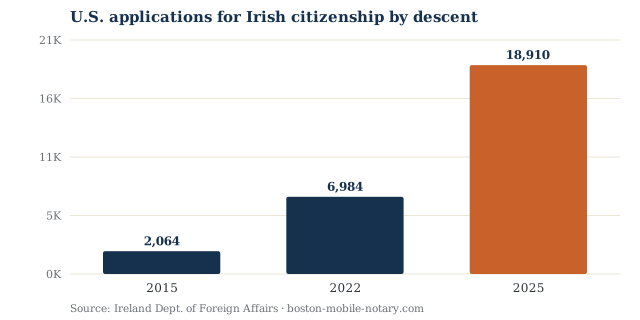
- U.S. applications to the Foreign Births Register rose from 2,064 in 2015 to 18,910 in 2025 — more than nine times higher. Ireland Department of Foreign Affairs (shared with Newsweek)#33
- A record 18,910 people applied from the U.S. for Irish citizenship through the Foreign Births Register in 2025. Ireland Department of Foreign Affairs (reported by The Irish Times)#34
- U.S. Foreign Births Register registrations numbered 11,601 in 2024, up 50% from 7,726 in 2023. Ireland Department of Foreign Affairs (reported by RTÉ)#35
- There were 6,984 U.S. Foreign Births Register applications in 2022. Ireland Department of Foreign Affairs FOI (via Irish By Descent / IrishCentral)#36
- Registrations from the U.S. made up 27% of all Foreign Births Register registrations in 2024. Ireland Department of Foreign Affairs (reported by RTÉ)#37
- Irish passport applications from the U.S. reached 31,825 in 2024, up almost 10%. Ireland Department of Foreign Affairs (reported by RTÉ)#38
United Kingdom
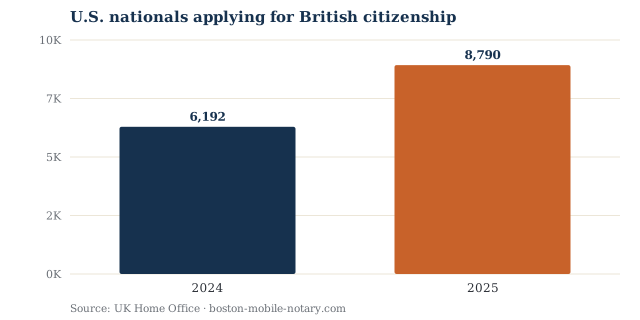
- A record 8,790 U.S. nationals applied for British citizenship in 2025, 42% more than the previous high of 6,192 in 2024. UK Home Office immigration statistics (reported by Bloomberg)#39
- 2,490 U.S. nationals applied for British citizenship in Q4 2025, the highest quarter on record. UK Home Office immigration statistics (reported by Bloomberg/Straits Times)#40
- 1,931 Americans applied for British citizenship in Q1 2025, then the most in any quarter in two decades of record-keeping. UK Home Office immigration statistics (reported by The Hill)#41
Germany
- Germany naturalized a record 332,500 people in 2025, up 14% from 2024. Destatis (Federal Statistical Office of Germany)#20
- 2025 was the first year with more than 300,000 naturalizations in Germany since its statistics began in 2000, and the fifth consecutive annual increase. Destatis (Federal Statistical Office of Germany)#21
- 6,600 U.S. citizens became German citizens in 2025, roughly double the number in 2024. Destatis (Federal Statistical Office of Germany)#22
- Germany received 467,400 naturalization applications in 2025 and completed 371,100 procedures, 90% of which ended in naturalization. Destatis (Federal Statistical Office of Germany)#23
- Syrians (65,600) were the largest group of new German citizens in 2025, followed by Turkish (34,100, up 51%) and Russian (19,700, up 51%) nationals. Destatis (Federal Statistical Office of Germany)#24
- Germany's 2024 citizenship reform generally allows new citizens to keep their previous citizenship. Destatis (Federal Statistical Office of Germany)#25
- New German citizens had lived in Germany for an average of 12.4 years in 2025, up from 11.8 years in 2024. Destatis (Federal Statistical Office of Germany)#26
Spain
- Spain had granted 237,145 nationalities to descendants of exiles under its Democratic Memory Law as of September 2025. Government of Spain (La Moncloa)#27
- Spain received 876,321 nationality applications under the Democratic Memory Law from October 2022 to September 2025. Government of Spain (La Moncloa)#28
- Consulates in Ibero-America and the Spanish Consulate General in Miami received more than 95% of Democratic Memory Law applications. Government of Spain (La Moncloa)#29
Italy
- Italy's Decree-Law 36 of 28 March 2025, converted into Law 74 of 23 May 2025, generally limits new citizenship-by-descent claims by people born abroad with another citizenship to those with a parent or grandparent who holds (or held at death) only Italian citizenship, or whose Italian parent lived in Italy for two years before their birth. Embassy of Italy (Ottawa)#44
- Italian citizenship-by-descent applications filed before 11:59 p.m. Rome time on 27 March 2025 remain under the old rules. Italian Consulate guidance#45
Canada and Mexico
- 90,490 Canadian citizens by descent living in Canada were born in the U.S. — the top birthplace for that group. Statistics Canada#42
- 797,266 people born in the United States lived in Mexico at the 2020 census — by far its largest foreign-born group (many are U.S.-born children of Mexican families). INEGI (Mexico)#43
Giving up U.S. citizenship
The IRS publishes the names of people who gave up U.S. citizenship or long-term U.S. residency each quarter. The list includes long-term green card holders as well as citizens.
- The IRS published 1,462 names of people who gave up U.S. citizenship or long-term U.S. residency (green cards) in Q1 2026, 1,781 in Q2 and 1,331 in Q3 — 4,574 in the first three quarters. IRS Quarterly Publication of Individuals Who Have Chosen to Expatriate (count reported by Newsweek)#46
- Only four quarters since the list began in 1996 have contained more names than Q2 2026's 1,781. IRS Quarterly Publication (analysis reported by IMI Daily)#47
- Federal Register expatriation notices covering 2024 contained 4,819 names (former citizens and long-term green card holders). Federal Register (count by Greenback Expat Tax Services)#48
- The published count peaked at 6,705 names in 2020; it was 5,409 in 2016. Federal Register (count by Greenback Expat Tax Services)#49
- In the seven complete years of data available between 2000 and 2008, Federal Register counts averaged just 452 names a year. Federal Register (count by Greenback Expat Tax Services)#50
- The State Department estimated FY2024 demand for Certificate of Loss of Nationality processing at 4,661 applications. U.S. Department of State (fee rule, Federal Register)#51
New U.S. citizens
- USCIS welcomed 818,500 new citizens in fiscal year 2024, a 7% decrease from the prior year. U.S. Citizenship and Immigration Services#30
- USCIS naturalized more than 7.9 million new citizens over the past decade. U.S. Citizenship and Immigration Services#31
- Mexico (107,700), India (49,700) and the Philippines (41,200) were the leading countries of birth of new U.S. citizens in FY2024. U.S. Citizenship and Immigration Services#32
Documents for a second citizenship
Nearly every second-citizenship application, whether by descent, marriage or residence, depends on official U.S. records.
- Vital records with an apostille. Birth, marriage, divorce and death certificates usually must be certified copies with an apostille from the issuing state. See how to get a Massachusetts birth certificate and our Massachusetts apostille services, or our apostille service for documents from all 50 states.
- Federal documents. Naturalization-related records and FBI background checks are authenticated at the federal level.
- Translation and legalization. Many countries require a certified translation, and countries outside the Hague Apostille Convention generally require embassy legalization.
Related data: Americans Moving Abroad Statistics and U.S. Passport Statistics.
Methodology
We found no official U.S. count of dual citizens, so this page combines the best available survey data with official figures from the governments that grant second citizenships, including Ireland's Department of Foreign Affairs, the UK Home Office, Germany's Federal Statistical Office and the Government of Spain, along with U.S. government sources and academic datasets. Each figure was confirmed on its source page, then checked again in a separate review against the same sources. Where official data reached us through news coverage, the source line names both the agency and the publication.
Applications, registrations and grants are different measures and are not directly comparable. Survey results reflect self-reported citizenship. We review this page every quarter.
Cite this page and download the data
You are welcome to use these statistics, charts and data files under a Creative Commons Attribution 4.0 (CC BY 4.0) license: free to use, with a credit link to this page.
Citation
Boston Mobile Notary & Apostille Service. (2026, November). Dual citizenship statistics (2026): 51 verified facts and figures. https://www.boston-mobile-notary.com/dual-citizenship-statistics.html
Link
<a href="https://www.boston-mobile-notary.com/dual-citizenship-statistics.html">Dual Citizenship Statistics – Boston Mobile Notary & Apostille Service</a>
Download all 51 statistics with sources (CSV)
Each file includes the citation and links back to this page.
Frequently asked questions
How many Americans are dual citizens?
No U.S. agency publishes an official count. In a December 2025 YouGov survey, 7% of U.S. adult citizens said they are already a citizen of another country. Writing in Henley & Partners' Global Mobility Report, Prof. Peter J. Spiro estimates that this equates to around 25 million Americans.
Does the United States allow dual citizenship?
Yes. The State Department says U.S. law does not prevent citizens from acquiring a foreign citizenship and does not require them to choose between U.S. citizenship and another nationality. U.S. dual nationals must use a U.S. passport to enter and leave the United States.
How many countries allow dual citizenship?
According to Maastricht University's MACIMIDE dataset, 76% of 200 countries allowed their citizens to acquire another citizenship without automatically losing their own by 2020. GLOBALCIT found that 49% of countries fully accepted dual citizenship in 2022.
Which second citizenships are Americans seeking?
Ireland and the United Kingdom are two of the clearest examples. A record 18,910 people applied from the U.S. for Irish citizenship by descent in 2025, and a record 8,790 U.S. nationals applied for British citizenship in 2025. Germany naturalized 6,600 U.S. citizens in 2025, roughly double the year before.
What documents do I need for citizenship by descent?
Most ancestry-based applications require official birth, marriage and sometimes naturalization or death records for each generation. Foreign governments usually require those U.S. records to carry an apostille, and many also require a certified translation. Requirements vary by country.
How often is this page updated?
We review every statistic each quarter, including after each new IRS expatriation list and major national citizenship releases, and update the date at the top of the page whenever figures change.
Applying for a second citizenship?
Apostilles, certified copies, embassy legalization and certified translations for every generation of your documents.